---
url: "https://github.com/slee-persis/GVS5H"
title: GVS5H
source_kind: github
author: slee-persis
captured: "2026-09-17T16:46:15+00:00"
comment_tree: false
topics: [models, qwen]
summary: GVS5H presents a training-free ledger-based orchestration method where five Qwen3.8-27B models match Claude Fable 5 on LiveCodeBench Hard, achieving 92.4% pass@1 at a fraction of the cost.
status: ok
---
# slee-persis/GVS5H
- stars: 612
- language: Python
- topics: —
- license: MIT
- created: 2026-08-26T20:56:52Z
- archived: False
---
# GVS5H: Five Qwen3.8-27B Models Match Claude Fable 5 on LiveCodeBench Hard
### Gvs5H: Gorilla vs. 5 Humans
## Results

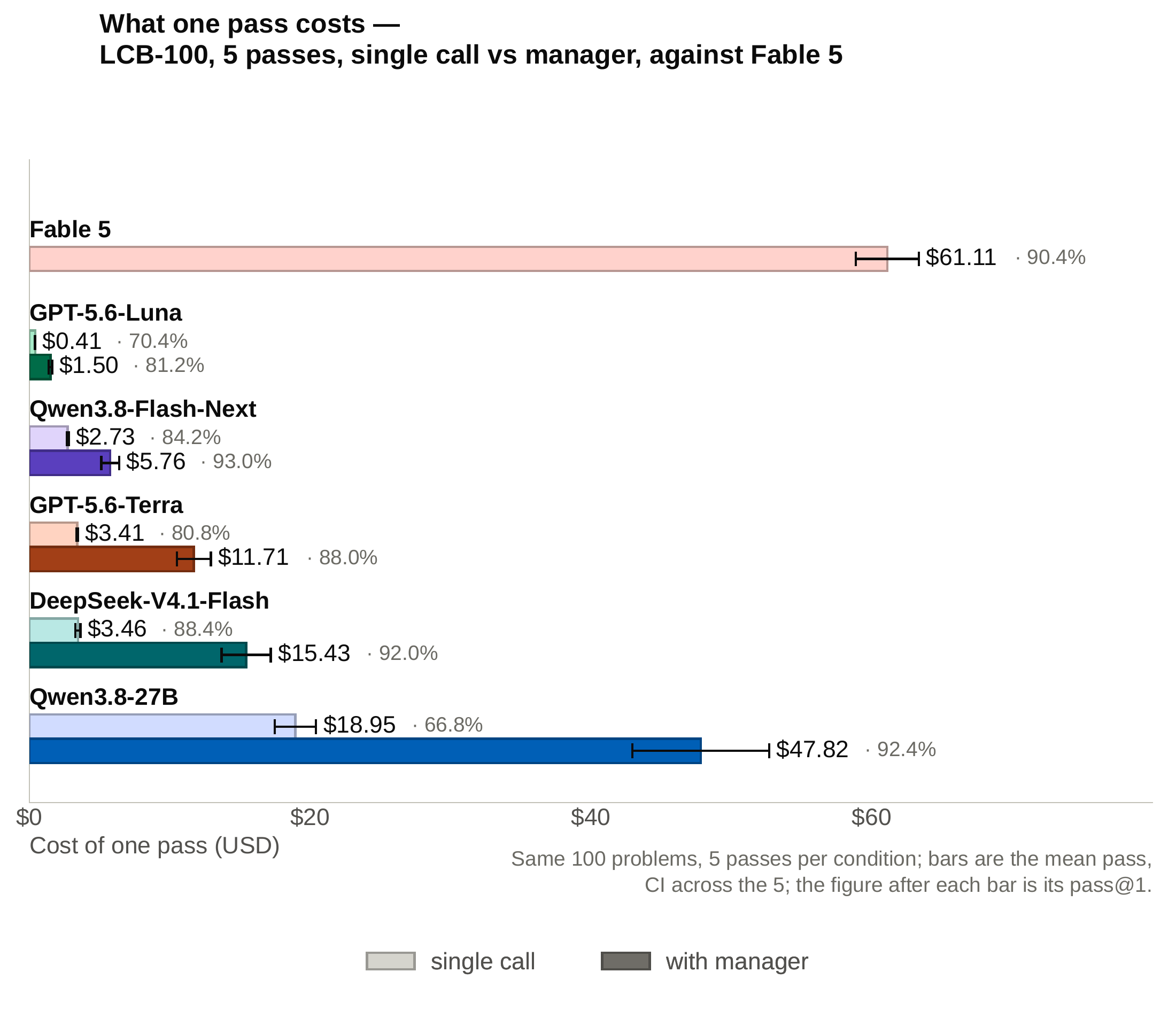
> **Abstract.** Frontier coding performance is typically bought with larger proprietary models at high cost. We introduce ledger-based zero-shot self-orchestration, a training-free method in which fresh instances of one model decompose problems and coordinate through a shared filesystem holding a plan, notes and current solution. Across nine open and closed-weight models on the 100 latest hard LiveCodeBench problems, the method yields gains of up to 23.2 percentage points on pinned backends and offers two routes to frontier-level accuracy. Orchestrated Qwen3.8 Flash Next reaches 93.0% pass@1 against Fable 5's 90.4% at 9% of the cost, and locally served, open-weight Qwen3.8-27B rises from 69.2% to 92.4%. Gains are not universal: some models are unchanged or worse. Transcript analysis attributes the gain to decomposition and persistent context. Inference-time organization can approach frontier coding accuracy at a fraction of the cost, or slightly exceed it on self-hostable weights.
>
> — [the paper](paper/iclr2027_conference.pdf)
## Running the code
Needs [uv](https://docs.astral.sh/uv/) and an API key for the model you want to test.
```bash
cd codebase/v2-current
export OPENAI_API_KEY=...
LCB_RELEASE=release_v6 \
ESCALATION_CLOUD_MAX_TOKENS=128000 \
ESCALATION_CLOUD_TIMEOUT=7200 \
MULTIAGENT_MODEL=openai:gpt-5.6-terra \
uv run --no-project --python 3.12 --with 'datasets<4' --with numpy --with anthropic \
python escalation/run_bench.py --engine multiagent --only lcb --lcb 100 --parallel 8
```
- `--engine multiagent` runs the manager; `--engine single` is the one-call baseline.
- Other models: `anthropic:`, `dashscope:`, `openrouter:`, each with its own `*_API_KEY`.
- The pass@1 score prints at the end. Results are written to `runs/results.json`, workspaces to `runs/ws/`.
## License
Code is under the [MIT License](LICENSE). The paper, figures and run data are under
[CC BY 4.0](LICENSE-CC-BY-4.0). The LiveCodeBench fork, the benchmark problem statements
and the LaTeX template files keep their own licenses. See [NOTICE.md](NOTICE.md) for
which license covers which path.